

What does ionisation mean in ESD areas?
What happens during ionisation
In ESD areas, electrostatic charges should be avoided or, better still, prevented from occurring in the first place by using ESD-compliant materials. Nevertheless, charges can develop as a result of certain processes: during assembly processes, when connecting cable lines, in machines or through conveyor technology. To name just a few examples.
These static charges can and must be reduced and neutralised to below 100 volts of process charge. Ionisers are used for this purpose. Another example is the packaging industry. Ionisers provide valuable services here: they prevent the disruptive sticking of plastic films or sleeves caused by electrostatic forces, which reduces packaging quality.
In addition, ionisers are indispensable in assembly and clean room processes. There, dust or other particles adhere to workpieces. Ionisation electrostatically neutralises the parts and reliably removes unwanted particles – for clean processes and optimal results.


Typical application of ionizers in electronics production
In the work situation shown, an electronic circuit board (PCB) is inserted into a highly electrostatically chargeable plastic housing.
Such housings can build up considerable electrostatic charges during handling, which can damage or destroy sensitive electronic components.
To avoid this risk, an ioniser is specifically used in the work process. The ioniser neutralises the electrostatic charge of the plastic housing and the immediate ambient air, thus ensuring safe, ESD-compliant installation of the board.
This significantly reduces the risk of ESD damage and ensures product quality in the long term.
Two different technologies: AC / DC
There are two different technologies used in ionisers: AC and DC. Both describe how the electric field works during ionisation – alternating or constant. The difference has a significant impact on the effectiveness, stability and efficiency of ionisers, as well as their area of application.

DC ionisation (direct current)
The voltage is applied constantly (positive and negative remain the same). With DC technology, positive and negative ions are produced simultaneously and applied to the surface to be ionised.
Advantages: Highly targeted and efficient ionisation with a high ion density, resulting in a strong neutralising effect that neutralises the process air very quickly and reduces charging.
It is important to note that regular checks must be carried out using charge plate monitors to prevent the balance from being disturbed and thus impairing ionisation.
Typical areas of application are
- ESD areas and clean rooms where targeted discharge below 100 volts is required.
- Areas with sensitive components such as semiconductors, displays, control units, etc.
AC ionisation (alternating current)
With AC technology, the voltage is alternating. This means that alternating positive and negative ions are produced and applied to the surface to be ionised.
As a result, the ionisation performance is lower than with DC technology and discharges take longer. Although these ionisers require less maintenance, they are significantly less precise than ionisers with DC technology and have a smaller effective range.
Typical applications include the ionisation of general processes with less sensitive components, such as in the packaging, printing and plastics industries.

| Technology | AC | DC |
| Polarity | alternating | constant |
| Ion type | + / − alternating | mostly single-pole |
| Precision | medium | high |
| Maintenance | low | higher, but can be reduced through regular inspection |
| Application | Broad, with less sensitive components, such as in packaging systems or the plastics industry. | Specialised, with sensitive components and parts, such as in ESD areas. |
Rule of thumb:
- AC if you want robust, uncomplicated discharge.
- DC if you need maximum control and precision.
Which ioniser is right for me?
Blowers or bars – tabletop or overhead
There are different types of ionisers: fans and bars. In ESD areas or at ESD workstations, blowers/fans are generally used. Thanks to the ionised air, these have a large ionisation range in which they are effective. In addition, fan ionisers can be positioned further away from the process and do not interfere with work.
Depending on the process area or space available, tabletop ionisers can be positioned on the work surface or overhead ionisers can be mounted on a beam above the work table. A simple rule of thumb: the more fans, the larger the ionisation area. The resulting air flow is harmless. The air flow can be adjusted using stepless adjustment options, but must not be too low, as otherwise the discharge power may be too low. This must be checked with a field meter or charge plate monitor.
Ionisation bars, on the other hand, are suitable for use in machines. They do not produce an air flow, but must be installed close to the process in order to deliver the necessary performance. Bars ionise the charge in the area of the bar length and not over a large area. For this purpose, the ionisation bars are produced in the required length and then mounted directly on the process.
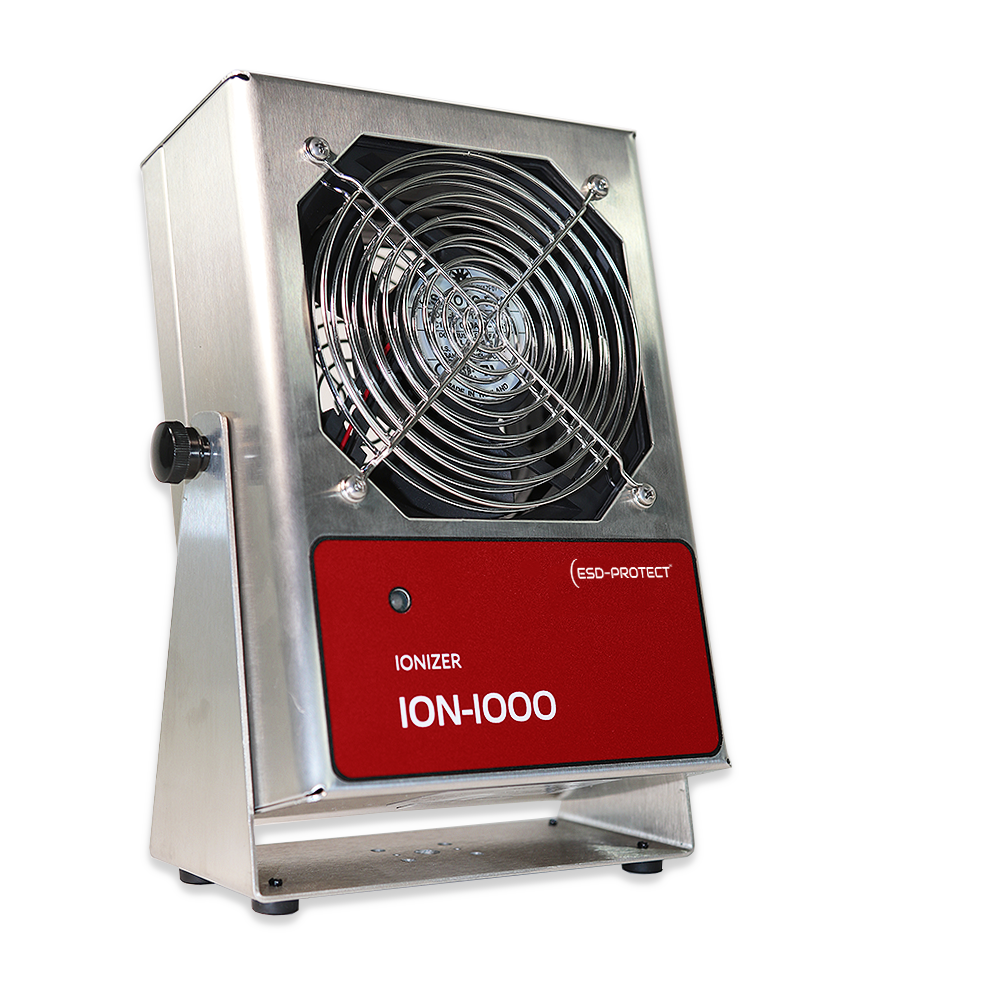


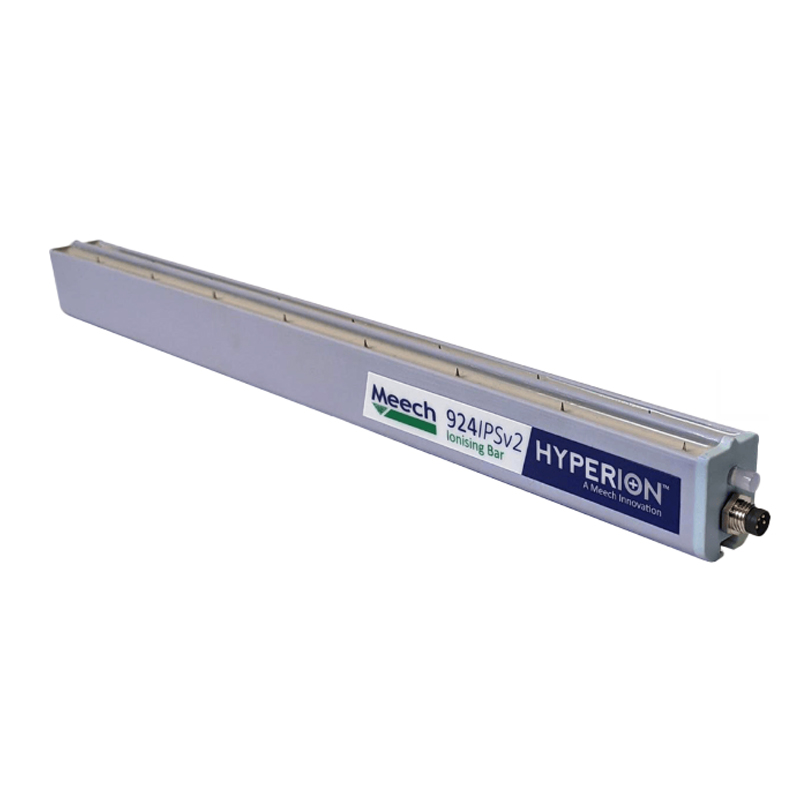
 EP0401045
EP0401026
 EP0402010-VH
EP0403022
EP0402027

Important: Regular inspection of ionisers
With the aid of charged plate monitors
Ionisers must be cleaned and inspected regularly because dust and dirt can greatly reduce their ionising effect. If the tips are dirty or worn, fewer ions are produced – and the electrostatic discharge no longer works reliably.
Regular cleaning and, if necessary, replacement of the tips therefore ensure that devices, components and workplaces remain effectively protected against electrostatic charging. The check is carried out using charged plate monitor systems.
Charged Plate Monitor (CPM)
A Charged Plate Monitor (CPM) measures in real time how well the ioniser is working and how quickly and efficiently the electrostatic charge is being neutralised.
The monitor can measure the ionisation rate of the devices. This means that it checks how effectively the ioniser is producing ions to reduce the static charge in the environment. According to the ESD standard DIN EN 61340-4-7, an ioniser must reduce a charge of 1000 volts to less than 100 volts within 10 seconds.
The Charge Plate Monitor charges a metal plate. As soon as this is placed within the effective range of the ioniser being tested, the charge on the plate is reduced. The better the ioniser works, the faster the plate discharges. Some CPMs measure the time directly and show the result on the display, while with other models you have to stop the time yourself.
According to the standard, the dimensions of the plate must be 15.2 x 15.2 x 15.2 cm (W x H x D).
More compact devices are available for regular testing (see Desco CPM).
