
ESD Wrist Straps
Grounding via the wrist
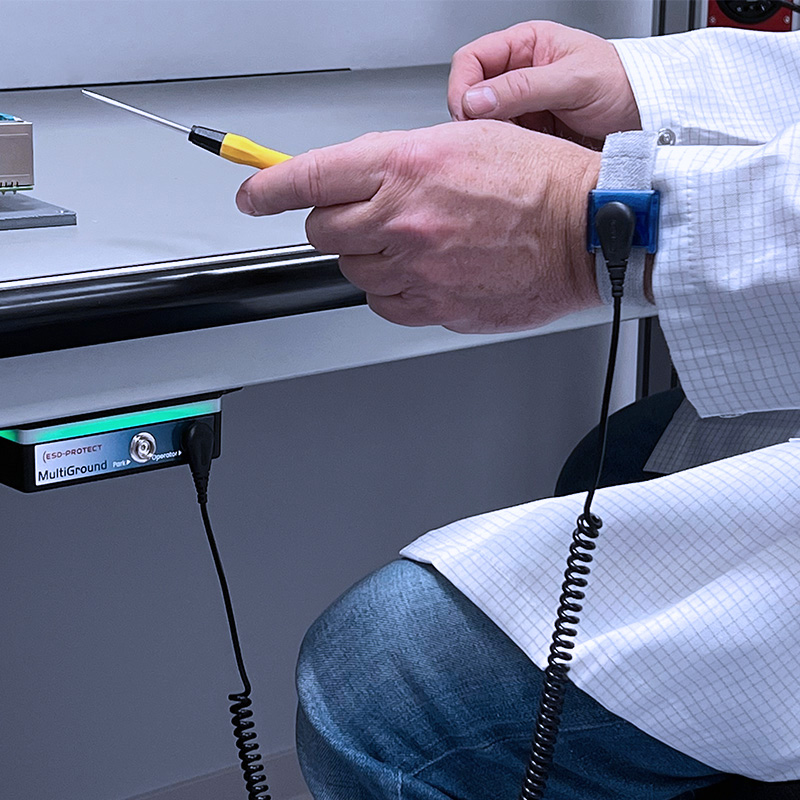
ESD wrist straps enable the permanent and controlled dissipation of electrostatic charges from the human body to earth potential.
They are an essential component of personal protective equipment in electrostatic protected areas (EPA) in accordance with IEC 61340-5-1.
 EP0105001-VH
ESD earthing bracelet, Jewel®
 EP0105039
Standard wrist strap
 EP0105011-VH
Wrist strap, metal, stainless steel back
 EP0105040-VH
ESD-Handgelenkband-Set mit ESD-Spiralkabel
 EP0105031-VH
 EP0105003-VH
ESD earthing bracelet, anti-allergic
 EP0105008-VH
ESD earthing bracelet, anti-allergic
 EP0105007
ESD Grounding Wristband, Hypoallergenic, DK4
 EP0105027
ESD earthing bracelet elastic, magnetic connection
 EP0105028
ESD earthing bracelet, metal with magnetic connection
 EP0105030
ESD earthing strap, thermoplastic
 EP0105029
ESD Wrist Strap
Grounding via the Wrist
ESD wrist straps enable the permanent and controlled dissipation of electrostatic charges from the human body to earth potential. They represent an essential component of personal protective equipment in electrostatic protected areas (EPA) per IEC 61340-5-1.
ESD Wrist Strap – Function and Construction
An ESD wrist strap consists of two components: the strap itself, which establishes direct skin contact, and the grounding cable with integrated 1 MΩ protective resistor. The protective resistor is required for safety reasons – it limits current flow to a safe level in the event of a fault, while simultaneously ensuring reliable dissipation of electrostatic charges. ESD wrist straps are connected to the central grounding point of the workstation via a snap fastener and must be regularly tested for functionality using an ESD personnel tester.
ESD Wrist Strap – Versions at a Glance
ESD wrist straps are available in various versions – depending on application area, wearing comfort and individual requirements:
- Elastic straps – Classic version with conductive elastic band, available in various widths and colours.
- Metal and stainless steel straps – Durable and hygienic, suitable for environments with heightened cleanliness requirements.
- Anti-allergic straps – Nickel-free version for persons with skin sensitivities or metal allergies.
- Straps with magnetic connection – Enable quick attachment and removal without loss of grounding connection quality.
- Single-use grounding straps – For visitors, auditors or temporary EPA access without reuse.
Standard Requirements and Regular Testing
Per DIN EN 61340-5-1 and ANSI/ESD S20.20, ESD wrist straps must be tested for functionality at least daily before the start of work. Testing is carried out using an ESD personnel tester, which measures the total resistance of the system – comprising strap, grounding cable and body resistance – and compares it against the normative limit values. The permissible total resistance per standard is between 750 kΩ and 35 MΩ. Defective or worn ESD wrist straps must be replaced immediately, as an interrupted or high-resistance strap no longer provides effective ESD protection.