
What distinguishes an ESD chair from a normal chair?
Conductive materials make ESD work chairs indispensable in ESD protection areas
ESD chairs comply with the ESD standard DIN EN 61340-5-1 and consist of conductive upholstery (seat and backrest), base, castors or glides. This prevents people from becoming charged through friction when sitting, standing up or rolling. An ESD floor is essential to ensure that the charge can be dissipated via the ESD castors.


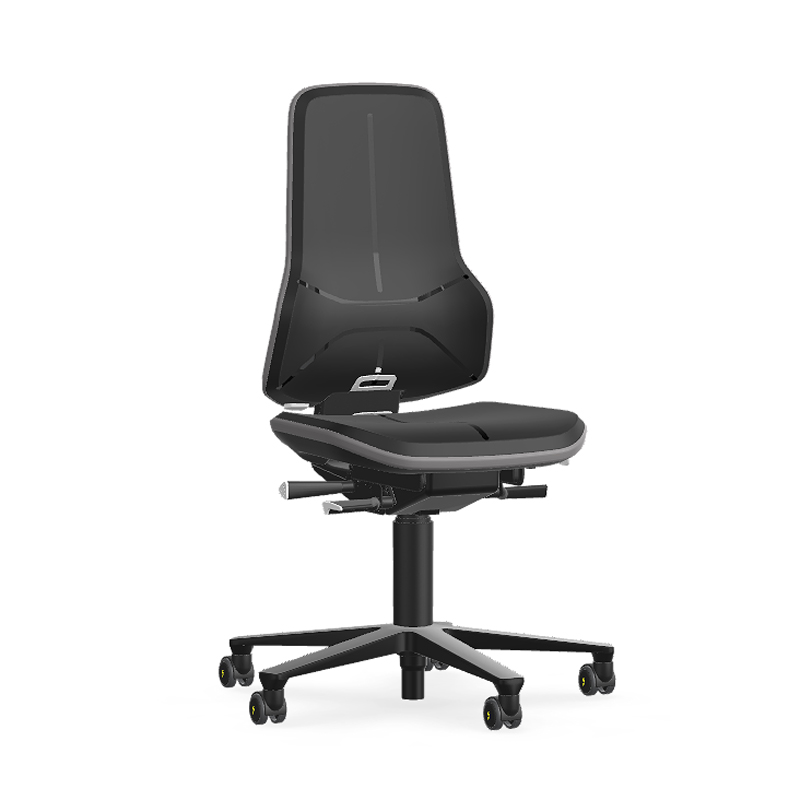


ESD Chairs for EPA Workstations: Selection and Use
An ESD chair is part of personnel grounding at the workstation. Anyone who sits, stands up or rolls generates electrostatic charge through friction between clothing and upholstery. An ESD work chair dissipates this charge in a controlled way via the cover, frame and casters or glides into the ESD floor. This requires a continuously dissipative construction: a single non-conductive component interrupts the discharge path.
ESD Office Chair and ESD Work Chair: Which Type for Which Application?
Different designs are used depending on the task. The ESD office chair is suited to office and administrative workstations within the EPA, for example in quality assurance, planning or test-area coordination. The ESD work chair is designed for production, assembly and repair, and typically offers a wider height adjustment range, robust mechanics and hard-wearing covers. For standing workstations and frequently changing postures, ESD stools, sit-stand supports and footrests are available. Stackable ESD chairs are mainly used in training and meeting rooms within the EPA.
Features That Matter
When selecting ESD chairs, the requirements of the workstation are as important as the discharge value. Key factors include the seat height range and fit for your employees, the adjustability of seat tilt, backrest and armrests, the type of cover (e.g. for cleanroom use or heavy wear), and the choice between casters and glides. ESD castors and armrests are also available as accessories, so existing chairs can be retrofitted and worn components replaced.
ESD Chair and ESD Floor: The System Has to Work as a Whole
Discharge takes place through contact between caster and floor. An ESD chair on a non-dissipative floor covering does not fulfil its protective function. Therefore, test chair and floor as a combined system in accordance with DIN EN 61340-5-1. Dirty or worn casters, as well as cleaning agents on the floor, can increase the resistance. We recommend including ESD chairs in the regular measurements of your EPA and cleaning or replacing casters as needed.
Advice on Equipping Your EPA
We support you in selecting the right ESD chair for your workstations, from individual equipment to planning complete production areas with coordinated tables, flooring systems and accessories.