
Detecting ESD events with the Eye-Meter
What is an eye meter?
A modular, multifunctional ESD monitoring and diagnostic device that is primarily used in ESD-sensitive production environments.
Depending on the module, it can measure the following:
1. EMI detection (electromagnetic interference)
Detects and displays ESD events caused by electrical discharges.
- Detects ESD events without contact through the electromagnetic fields they generate.
- Measures the voltage and polarity of ESD discharges.
- Counts how many ESD events have occurred in a given period of time.
- Provides a qualitative assessment of ESD risks in a zone.
2. ESD event detection(Event Detection Module)
- Measures the voltage and polarity of ESD discharges.
- Counts how many ESD events have occurred in a given period of time.
- Provides a qualitative assessment of ESD risks in a zone.
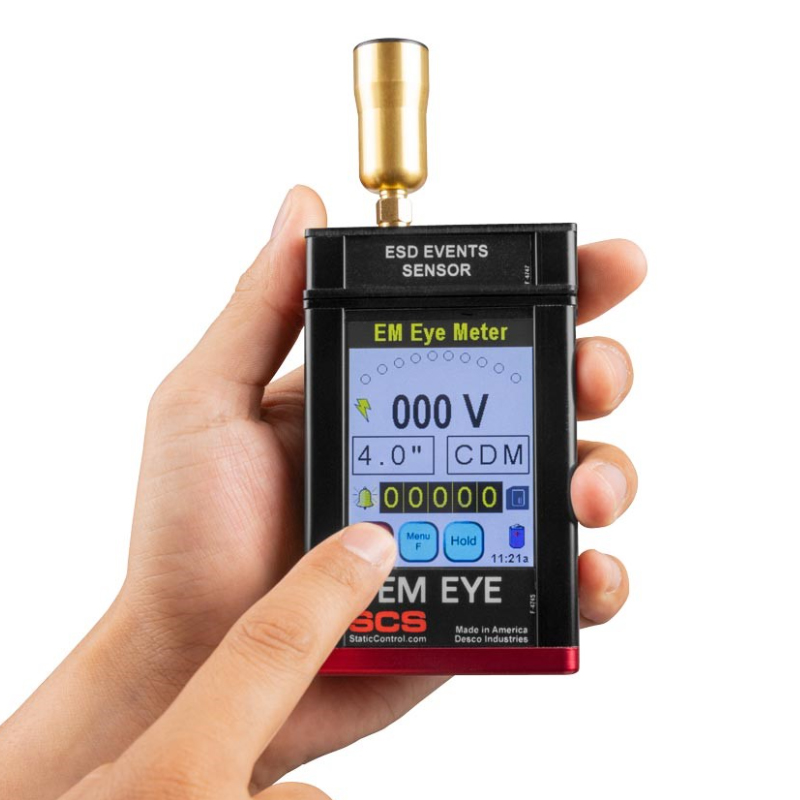
 EP0201100
SCS EM EYE-Meter Multifunction Measuring Device 770715
 EP0201035
ESD sensor for EYE-Meter CTC021
 EP0201071
Remote antenna for eye meter CTC115-6FT
Applications of the Eye-Meter in the EPA
The Eye-Meter is particularly suited for the diagnosis and localisation of ESD problem areas in existing production environments. Typical application scenarios include the analysis of production lines with increased reject rates, the inspection of newly established EPA areas and accompanying monitoring during internal audits. As the device detects ESD events without contact, it can be used during ongoing production operations – without interrupting manufacturing processes.
Eye-Meter as a Complement to Classical ESD Metrology
Classical ESD measurement devices such as resistance or field meters capture the static condition of materials and surfaces at a defined point in time. The Eye-Meter supplements this metrology with the dynamic component: it makes visible when, how frequently and with what intensity ESD events actually occur during ongoing operations. This combination of static resistance measurement and dynamic event detection enables a complete assessment of the ESD situation in an EPA zone.